Latest
Feeling imposter syndrome? Good. Here's why.
Peak Performers newsletter

Tiffany Uman
·
Mar 30, 2026
Feeling like a fraud? Good. You’re on the right track.
Imposter syndrome isn’t a sign of weakness. It’s a signal that you’re growing.
It shows up in the moments that matter most...when you’ve landed a big role, been asked to lead something new, or are stepping into a new chapter.
That’s when that voice creeps in saying
"I’m not ready for this."
"Someone’s going to realize I’m winging it."
"I don't belong here."
Earlier in my career at L’Oréal, I found myself without a direct boss for over 6 months. I was suddenly expected to lead our entire marketing team through back-to-back launches, manage agency partners, and present to the executive committee solo. I remember standing in the bathroom before a big meeting with my hands shaking thinking, "Can I really do this?"
That’s when I realized that no one was going to give me permission to lead. I had to step into it myself.
That year, I spearheaded one of our highest-performing campaigns, built 1:1 relationships with my executive team, strengthened my visibility across departments and landed my next promotion fast.
Here’s the shifts I made (and how you can do it too).
3 ways to use imposter syndrome as a career catalyst
1. Upgrade your self-talk
The way you speak to yourself, especially in high-stakes moments, can either build your courage or chip away at it. That voice in your head may be feeding you criticism like:
"You should know this already."
"You’re going to mess this up."
"You’re not as good as they think."
Start by catching these thoughts in the moment. Then, swap them out for self-talk that’s both truthful and constructive. Here’s a few examples to inspire from:
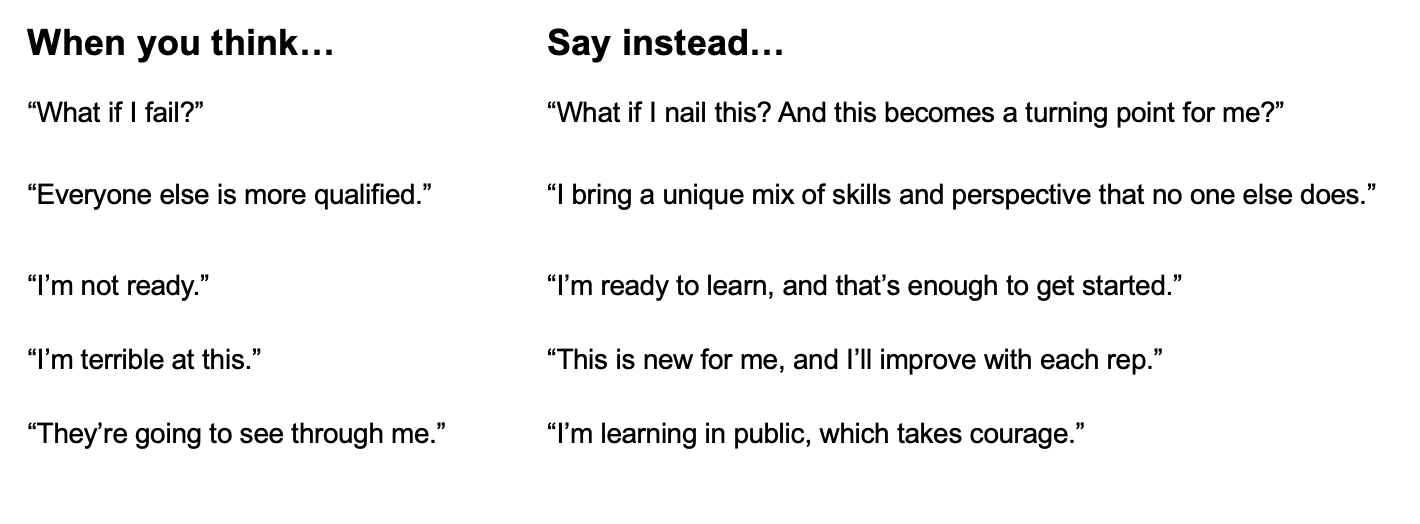
Pro tip: Start your day by writing or reciting 1 self-affirming sentence. Something like:
"I’m in the right room. I have value to add today."
"Just because I haven't done it before, doesn't mean I can't."
"I've done hard things before. This is simply another example I'll look back on."
Upgrading your inner dialogue is not about blind positivity. It’s about accurate self-perception.
If you don’t believe in your potential first, it’s 10x harder to get others to.
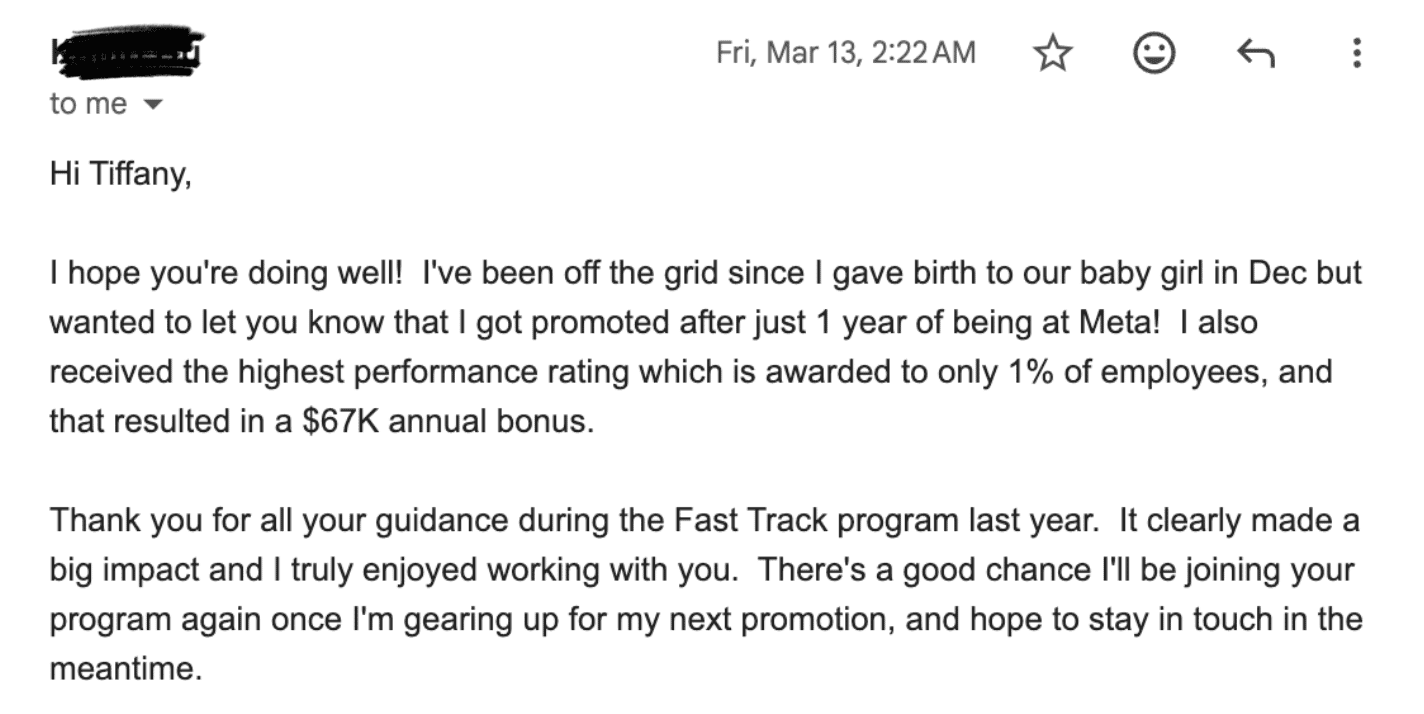
This is exactly what I supported one of our clients on recently at Meta. She had been there less than a year and was heading on maternity leave in just 3 months. She was trapped in a double-shot of imposter syndrome, convinced she was too new and the timing was wrong to even ask for a promotion. We stopped the permission-seeking and shifted her strategy to high-leverage visibility before her leave started.
The result? She secured her promotion in her first year and landed the highest performance rating, awarded to only 1% of employees. She headed into maternity leave with a $67K annual bonus and the peace of mind that she didn't have to 'wait her turn' to be recognized as a leader.
2. Lead with questions, not pressure
Imposter syndrome tells you that to be seen as credible, you have to have all the answers. But real leadership isn’t about knowing everything. It’s about asking the right questions at the right time.
→ Use clarifying questions to show your leadership in ambiguity:
"Can we take a step back and align on the primary objective before we dive in?"
"What constraints or trade-offs should we keep in mind here?"
"Is there a precedent for how this was handled before or would this be net new?"
→ Use alignment questions to build credibility with cross-functional teams:
"From your perspective, what would make this initiative a success?"
"Are there any potential blind spots you think I should be aware of?"
"What’s 1 thing you wish others asked before jumping into this kind of project?"
→ Use contribution questions to ease into high-stakes discussions:
"Would now be a good time to offer an alternate point of view?"
"So what I'm hearing is...Did that capture everything we covered?"
"I have a few thoughts based on what’s been said. Would it be helpful if I shared them?"
Pro tip: Questions build your influence. Asking smart, intentional questions positions you as someone who thinks before they speak, which builds trust with peers and execs alike.
3. Anchor yourself with evidence
Imposter syndrome feeds off of what you don’t know, what you assume others think, and what you fear might happen. The best way to shut it down is to turn ambiguity into evidence.
When that self-doubt kicks in, your brain scans for proof to support it. You start remembering past mistakes, or comparing yourself to someone 5 steps ahead.
But what if, instead of asking "Why me?" you asked, "What do I already know to be true about my value?"
→ Create a cheer folder: Start a running document or folder where you track:
Positive feedback (Slack messages, emails, performance reviews)
Key wins from projects, launches, or presentations
Milestones you’ve hit: promotions, new responsibilities, recognition
"I led a cross-functional project with 4 departments and beat our launch timeline by 3 weeks. That’s proof I can lead at this level."
Revisit it before a big meeting, interview, or career chat. It serves as a concrete reminder of how far you’ve already come.
→ Use structured reflection: When self-doubt creeps in, ask yourself these 3 evidence-based prompts:
What challenge did I navigate recently that I couldn’t have handled a year ago?
What feedback have I received in the last 30 days that confirms my growth or impact?
What’s 1 win from this past week, big or small, that I made happen?
→ Use data in conversations: The right evidence is a strategic tool in how you communicate.
Instead of saying: “I think I’ve done a pretty good job in this role.” Say:
“Since stepping into this role, I’ve launched 3 key initiatives, reduced turnaround time by 25%, and onboarded 2 new team members. I'd love to chat about where I can make greater impact."
Pro tip: Every Friday, take 15 minutes to jot down 1 learning, 1 win, and 1 area you’re improving. Over time, it becomes your personal growth dashboard to consistently level up beyond your comfort zone.
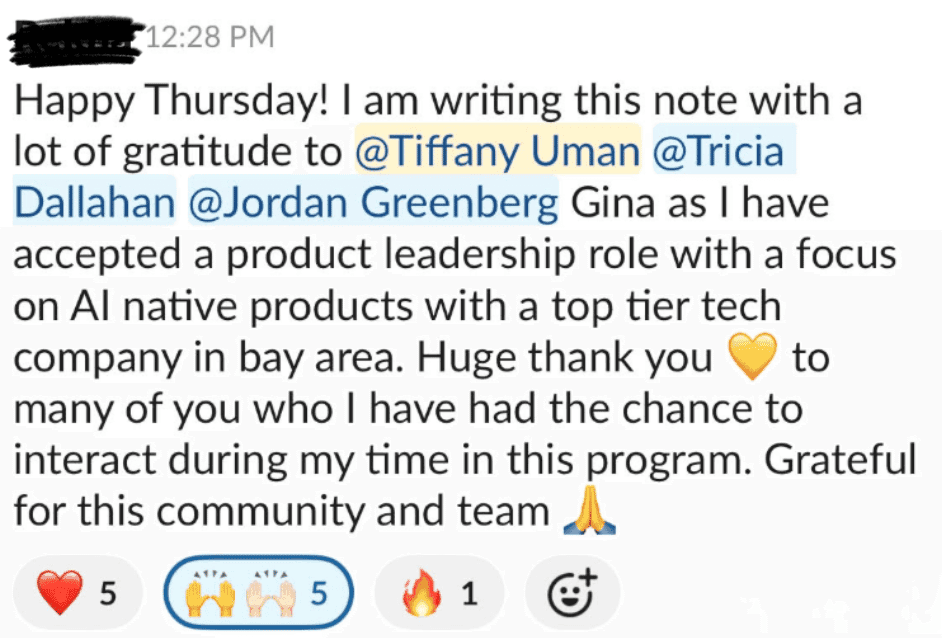
This is the strategy we used with our client who had faced imposter syndrome in her job search after struggling with multiple rejections. She knew she had the skill to go for the senior leadership role she wanted in tech, but was selling herself short.
Together, we sharpened her elevator pitch and interview strategy, pulled in the right hero stories and accomplishments to solidify her candidacy and improved her communication delivery through role-play practice. Shortly after, she secured her target leadership role at her top company of choice.
You've got this!
Free Peak Performers newsletter
Practical career tips that actually work.
Every Monday and Friday, get easy-to-use strategies and scripts to land better roles, faster promotions and more growth (and look great in front of your boss).
100% free • unsubscribe anytime.