Latest
How to manage up without overstepping
Peak Performers newsletter

Tiffany Uman
·
Feb 23, 2026
Most women I speak with think managing up means checking in, staying visible, or being helpful.
But those who do it best? They see it as something much more powerful.
A chance to make their boss’s job easier while accelerating their own growth.
They don’t wait for direction.
They don’t flood their manager with updates.
And they don’t cross lines trying to prove themselves.
They anticipate, simplify, and influence.
When done right, managing up builds trust, earns you more autonomy, and makes you the person your boss turns to when it matters most.
This was a key topic I covered in the 2 last workshops I delivered at Microsoft HQ at Redmond, helping their 63-64s position themselves best for achieving Director-level roles.
Here’s how to do it the right way without overstepping.
1. Anticipate what they need before they ask
One of the highest forms of value you can provide is thinking ahead of your manager's blind spots, bandwidth, and upcoming priorities.
You’ll gain respect not just for being efficient, but for being proactive.
Here’s how to start:
→ Revisit your boss’s quarterly goals. Align your updates, priorities, and suggestions around them.
→ Pre-read team meeting agendas and offer context or materials in advance to enrich the conversation.
→ Think in terms of "next 2 steps" instead of just the "next task."
Use language like:
“I know you’re prepping for Monday’s LT meeting. I’ve drafted a summary slide on our pilot results in case it helps support your recommendation.”
“You mentioned speed is critical this month. I’ve pre-vetted 2 vendors who can start by Friday if needed. I recommend we go with vendor A and here's why.”
I recently coached one of our clients on this. Her company was recently acquired and she was anxious about how to navigate this transition while speaking up with her new executive leaders. Self-doubt and overthinking held her back in the past, and she didn't want this pattern to keep repeating itself. We nailed down strategic scripts to use, role-played them together and ensured she was clear in her delivery. She crushed both meetings and got immediate positive feedback from her leadership team.

2. Lead with options, not problems
When something’s not working, don't just flag the issue and wait. Instead, come with choices.
Your boss shouldn’t have to problem-solve everything for you. They’ll trust you more if they see how you think, decide, and act, even when the situation is messy.
Here’s how to frame your updates:
→ Explain the challenge clearly, with context.
→ Offer 2-3 solutions, including your recommendation.
→ Clarify what you need from your boss (if anything) and how their support facilitates the outcome.
Some examples include:
“We’ve hit a blocker with data sync between tools A and B. I’ve mapped out 3 options, with pros and cons. I’d lean toward Option 2 because of the minimal rework, but we’d need our development team's support by next Tuesday. Thoughts?”
“The agency missed last week’s deadline. I’ve already escalated and secured an updated timeline. We’re still on track, but I’ll add a 48-hour buffer going forward.”
[Check out my deeper dive, free tutorial on how to look good in front of your boss].
3. Position yourself as a partner, not just a doer
Your boss wants to feel like they have a right hand and ally.
That means showing ownership, making decisions when appropriate, and seeing your role through a leadership lens, not just executing tasks day-in and day-out.
This doesn’t mean overstepping. It means stepping up.
→ Own the full outcome, not just your tasks.
→ Show how your work ladders up to bigger goals (i.e. divisional priorities, hot topics, solving pain points).
→ Offer to take the lead on cross-functional initiatives, when relevant.
Use phrases like:
“I took the initiative to connect with the Sales team on this and they confirmed alignment, giving us the green light to proceed.”
“This new workflow not only reduces our team’s time by 20%, but could streamline Marketing’s review process too. Happy to present this cross-functionally if helpful.”
“I’d love to own the end-to-end rollout. Would you be open to me leading that initiative?”
You want your boss and senior leaders to view you as someone who moves the business forward. This is particularly important when it comes to promotion decisions. Why?
Promotion decisions are rarely made by just your boss. The more you elevate yourself as a strategic partner to key decision-makers, the clearer it becomes that you can handle that next level of responsibility.
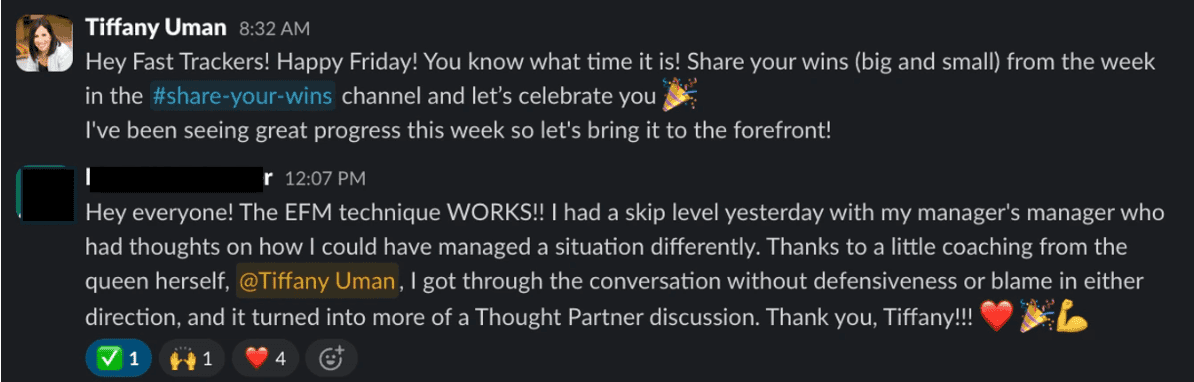
This was the approach our client used who was new in her role and had to address a more delicate situation with her skip-level. In role-playing the script I created for her, she positioned herself as a thought partner and instantly boosted her credibility in their eyes.
You've got this!
Free Peak Performers newsletter
Practical career tips that actually work.
Every Monday and Friday, get easy-to-use strategies and scripts to land better roles, faster promotions and more growth (and look great in front of your boss).
100% free • unsubscribe anytime.